Showing posts with label Dapkewitch. Show all posts

Tuesday, 29 March 2016

Arrivals from China and Japan

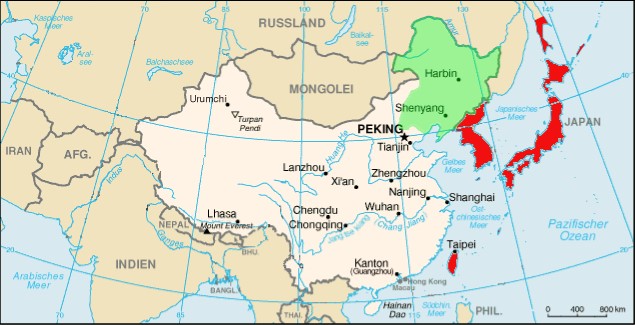
The Australian Lithuanian Community Archives are located in Adelaide, South Australia, and managed by Daina Pocius. In 2016 Daina posted an interesting item on her blog 'SA Lithuanian History' about Lithuanians in Harbin, China, in the 1930s (click here for a link to that post). That prompted me to think about what other records might exist of Lithuanians arriving in Australia from Harbin (Manchuria) or elsewhere in East Asia.


China, early 1930s, with Japanese occupied Manchuria and Harbin (source:http://www.balticasia.lt/straipsniai/istorija/lietuviai-kinijoje-xix-1940-m/ ) 

A 2014 article 'Lithuanians in China, 19th Century to 1940' by Gediminas Giedraitis on the BalticAsia website (in Lithuanian) provided an introduction to how and why some people had made their way to eastern China, over 4000 km from their birthplace. The first group to arrive were participants or supporters of the 1863 uprising who had been banished to Siberia and from there escaped into China. They were followed by several other waves of deported or displaced Lithuanians who also decided that life in China was a better option. There was also one significant group of voluntary migrants, the construction workers who came to work on the East China Railway at the end of the 19th century and stayed. By the 1930s there were an estimated 1000 Lithuanians residing in eastern China, including perhaps 350 in Harbin and 150 in Shanghai.

Lithuanians in Shanghai (1920s/30s)
 (source:http://www.balticasia.lt/straipsniai/istorija/lietuviai-kinijoje-xix-1940-m/)  


Then I consulted Elena Govor's book Russian Anzacs in Australian History and found that the route from the Russian Far East to Australia was not an unusual migratory route in the early 20th century (pp 22-23):
This choice of route was encouraged to some extent by the activities of emigration agents in far-eastern ports and the availability of steamship services to Australia. These Russians usually came via Harbin (China) and the Japanese port of Moji, from where Japanese steamships sailed ... [to] Darwin, Cairns, Townsville, Brisbane, Sydney and Melbourne.  ... Almost all of them disembarked at Brisbane.


Here are some examples of these migration patterns. Although in many cases we have scant details, there is enough to see that this was a regular corridor for people who had either settled in China or used it as a transit route:

1910: The ROMASZKIEWICZ family arrived in Brisbane from Nagasaki, Japan, aboard the Kumano Maru. Sigismund Romaszkiewicz was born in Krekenava, Lithuania, in 1876 and appears to have lived in Harbin from at least 1900; this link to the Russian Anzacs website provides more details.

1911: The DAPKEWITCH family arrived in Brisbane aboard the Yawata Maru. Jan (John) Dapkewitch had been born in Vilkaviskis in 1877 and married Paulina Svershchevska in Harbin in 1905. They had had two children before arriving in Australia: Nina, born in Belarus in 1906, and John, born in Kamchatka in 1910 (source: Foster Family Tree on ancestry.com.au).

1911: Vladislav SCHILLER arrived as a single man in Melbourne on the regular steamer service operated by the Yawata Maru. He was born in Lida or Vilnius in 1889, had worked in Harbin on the railway, and soon found employment as a fitter and turner at West Footscray. He married Elizabeh Eldridge in 1915 and was naturalised in 1922. Vladislav later moved to Sydney and died there in 1968 (source: Turnbull Wasson Tree on Ancestry.com.au).

1911: Joseph MANJIKE, born in 1873 in Vilnius, arrived in Brisbane from Manchuria. See my earlier post on Joseph here.

1914: Edward Charles PHILLULE (?PILIULIS), born in 1881, arrived in Brisbane from Japan aboard the St Albans; see my earlier post on E C Phillule here.

1923: Josephine RUCKMAN, born in 1863 in Kaunas, arrived at Brisbane on the Yoshino Maru with her sons John and Felix and a daughter (source: National Archives of Australia).

1923: Bronislau KRETOVITCH, born in Vilnius in 1889, had first arrived in Brisbane on the Yawata Maru in 1911 leaving his wife Vida and family behind in Harbin. After service in the AIF during World War 1 (see the Russian Anzacs link here) he made a return visit to Harbin and then came back to Australia in 1923, arriving in Melbourne from Kobe on the Tango Maru.  He was followed by his daughter Jadvyga Kretovitch who arrived in Melbourne in 1928 on the Aki Maru.    

1938: The AGRANOFF family arrived in Sydney aboard the Kamo Maru. The Jewish parents Chaim and Rachel had been born in Lithuania, but their children Faivel (Paul) and Sara Lia were born and raised in Harbin (source: National Archives of Australia).

Harbin in the 1920s (commercial postcard)


In 2020 Laurynas Kudijanovas, a student at Vilnius University, wrote his Master's thesis about Lithuanians in Asia during the early 20th century 'Lietuviai Azijoje 19001939 metais: kultūrinės istorijos siužetai apie lietuvybės raišką ir diplomatus Rytų kraštuose'. His research sources included this blog and the Australian Lithuanian Archives.


Monday, 7 September 2015

Queensland #1

Migrants with origins in Lithuania started settling in Queensland in the second half of the nineteenth century.  However it was not until after World War 2 that larger numbers were located there; for example, several hundred Lithuanian DPs (displaced persons) were brought to Queensland in 1948 and 1949 to cut sugar cane.  While most of these workers did not stay on the cane fields for longer than required, some settled further south and helped establish a Lithuanian community in Brisbane.

Probably one of the earliest migrants was Lewis FLEGELTAUB.  Born in the Suvalkija region in a Jewish family, he became a successful Australian businessman and died in Brisbane in 1897.  Trove and Ancestry.com contain more details of the Flegeltaub family.

Previous posts have noted men with origins in Lithuania who enlisted in Queensland during World War I:
  • P. KALINAUSKAS/ William KALINOVSKY/KALIN from Žagarė who enlisted at Cloncurry and served on the Western Front.  After the war he eventually settled in Brisbane and died there in 1937;
  • Sigismund ROMASZKIEWICZ, a Russian Pole from Krekenava who enlisted in Brisbane and also served on the Western Front.  He lived in Brisbane until his death in 1949;
  • Gerard SKUGAR, a Pole from Vilnius, who enlisted at Rockhampton and also served on the Western Front.  
In addition the following Queensland ANZACS who are listed on the russiananzacs.net site appear likely to have had Lithuanian origins:
  • Jack/Ivan TRINKOON (TRINKŪNAS?) from Brisbane.  Although born in Riga (Latvia), his service records show that his father was from Vilnius;
  • Charles Anton GEDGAWD (GEDGAUDAS?) from Charters Towers, born in Libau/Liepaja (Latvia) is associated with very Lithuanian names; his mother Domicelė referred to him as Kasimir (Kazimieras). 

The interwar years saw small numbers settling in Brisbane and regional Queensland.  In contrast to other Australian ports, arrivals at Brisbane often came from China or the Russian Far East.  Most of these settlers had Jewish, Polish, Russian or Prussian heritage, for example:

  • Chane MILERIS, known as Noel Miller, had arrived in 1930 as a Lithuanian national and was living in Brisbane in 1938;
  • Abraham WEINER/Alfred WYNER, a Lithuanian national born in Courland (Latvia) arrived in Australia around 1913 and was living in Brisbane in 1939;
  • Jan/John DAPKEWITCH from Vilkaviškis had married in Harbin, China, in 1905. He died in Ipswich in 1941 aged 63;
  • Josephine RUCKMAN, a Polish widow from Kaunas with Lithuanian citizenship, arrived in Brisbane on the Yoshina Maru in 1923 with her two sons John and Felix and daughter-in-law Klara in 1943, aged 77, she was living in Mackay and one son was farming at Alligator Creek near Mackay;
  • Anton YUSKAN (from Lithuania but birth location not stated) married in Proserpine and died there in 1973 aged 84;
  • Veniamin SAMOLLOFF, a Lithuanian national from Kaunas, had arrived around 1925 and was living at Victoria Point, near Brisbane, in 1932;
  • Bruno GREITSCHUS, a Lithuanian national from Memel (Klaipėda), had arrived around 1925 and was working at Goolburra Station, Offham Siding (western Queensland) in 1937;
  • Frederich WEDRAT, also from Memel, had arrived in 1910 and was living at Chinchilla when he died in 1963, aged 73.
The 1933 Australian Census recorded 12 males and 3 females who had been born in Lithuania and were then living in Queensland; 4 of the men were living in 'tropical Queensland'.

Prior to World War 2 there was only a handful of ethnic Lithuanians living in Queensland at any one time.  Metrastis No. 1 (p10) records that Edward Charles PHILLULE (PILIULIS) wrote in 1938 that there had been five Lithuanians in Brisbane but two had died, one had returned to Lithuania, and there there were only two left.  The other Lithuanian referred to in that correspondence was probably RUZGYS (Australian Lithuanians, p25).

The first significant influx of Lithuanians to Queensland occurred in 1940 when 30 Lithuanian refugees with British citizenship arrived from Vladivostok aboard the Haitan.

Next week's post will look at one of the few ethnic Lithuanians living in Queensland at that time, E. C. Phillule.